
Ham Band Chart
Which frequencies can you use with your license? Enter a frequency and your license class to see the band, whether you have privileges there and which modes are allowed, then check the chart below for every band from 160 metres to 23 centimetres. The chart summarises US FCC Part 97 privileges; always confirm against the current official band chart before transmitting.
- Free to use
- No sign-up
- Runs in your browser
Frequency privilege checker
Ham Radio Shack Reference Pack
Printable US band privilege chart by license class, a dipole and vertical antenna length table, a station logbook (PDF and Excel) and a Q-code and phonetic alphabet card.
- Band chart (PDF)
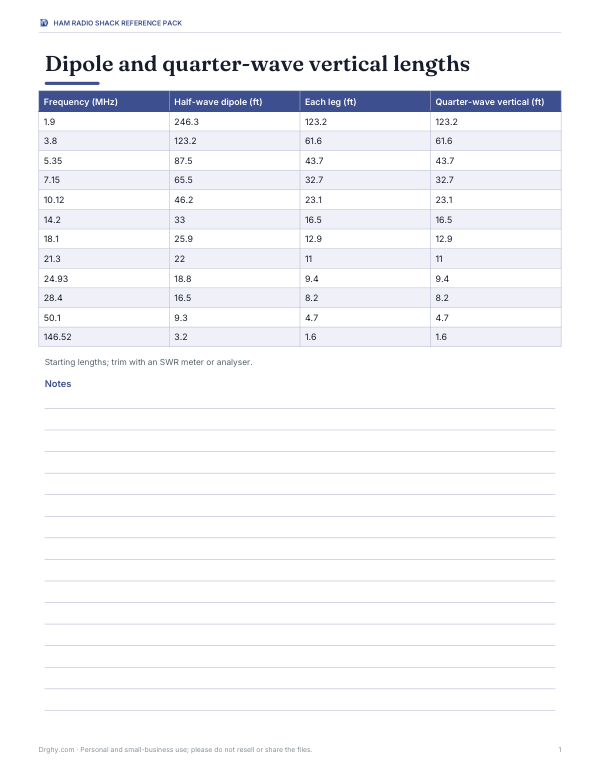
- Antenna lengths (PDF)
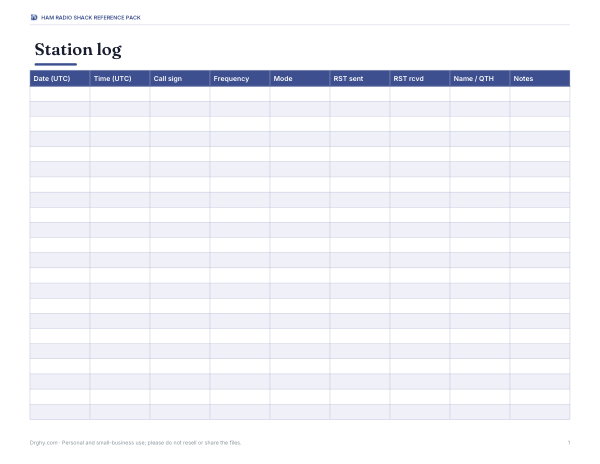
- Logbook (PDF/XLSX)
- Q-codes card (PDF)
Formats: PDF, XLSX. Instant download after payment (link valid 72 hours, up to 5 downloads). AI-assisted: the templates were drafted with AI help and reviewed and laid out before publishing.
$4.00 USD, one-time 4 files · about $1.00 each
- Instant download
- 7-day refund
- Secure checkout by Stripe
7-day money-back guarantee. Full refund within 7 days of purchase, even after you download.
Free sample: Antenna Length Table (PDF, 69 KB)
Full refund within 7 days — see the refund policy and license.
Free printables
Single sheets you can print right now, no sign-up. The full pack adds every sheet in one download plus the editable files.
 Printable Q-Codes and Phonetic Chart
US license classes
| Class | Exam | Privileges in brief |
|---|---|---|
| Technician | 35-question Element 2 | All amateur bands above 50 MHz; limited CW on 80, 40 and 15 m; CW, data and SSB phone on part of 10 m |
| General | Element 3 (after Technician) | Most HF phone and data segments worldwide-capable |
| Amateur Extra | Element 4 (after General) | All amateur privileges, including the lower edges of the HF bands |
Older Novice and Advanced licenses can still be renewed but are no longer issued; their privileges are listed in the official FCC tables.
HF band chart
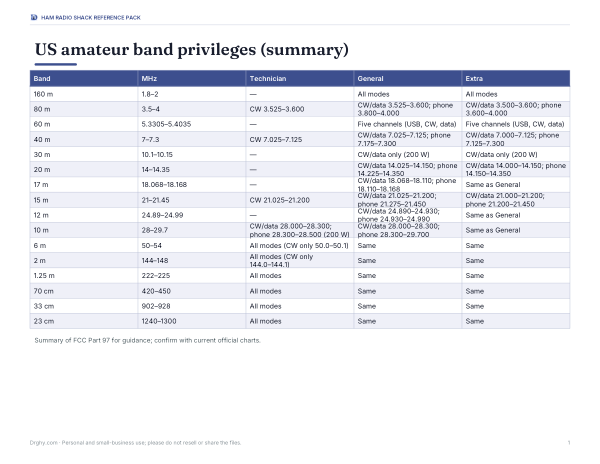
| Band | MHz | Technician | General | Extra |
|---|---|---|---|---|
| 160 m | 1.8–2 | — | All modes | All modes |
| 80 m | 3.5–4 | CW 3.525–3.600 | CW/data 3.525–3.600; phone 3.800–4.000 | CW/data 3.500–3.600; phone 3.600–4.000 |
| 60 m | 5.3305–5.4035 | — | Five channels (USB, CW, data) | Five channels (USB, CW, data) |
| 40 m | 7–7.3 | CW 7.025–7.125 | CW/data 7.025–7.125; phone 7.175–7.300 | CW/data 7.000–7.125; phone 7.125–7.300 |
| 30 m | 10.1–10.15 | — | CW/data only (200 W) | CW/data only (200 W) |
| 20 m | 14–14.35 | — | CW/data 14.025–14.150; phone 14.225–14.350 | CW/data 14.000–14.150; phone 14.150–14.350 |
| 17 m | 18.068–18.168 | — | CW/data 18.068–18.110; phone 18.110–18.168 | Same as General |
| 15 m | 21–21.45 | CW 21.025–21.200 | CW/data 21.025–21.200; phone 21.275–21.450 | CW/data 21.000–21.200; phone 21.200–21.450 |
| 12 m | 24.89–24.99 | — | CW/data 24.890–24.930; phone 24.930–24.990 | Same as General |
| 10 m | 28–29.7 | CW/data 28.000–28.300; phone 28.300–28.500 (200 W) | CW/data 28.000–28.300; phone 28.300–29.700 | Same as General |
“CW/data” segments allow Morse code, RTTY and digital modes; “phone” segments also allow voice and image modes. CW is permitted throughout every band.
VHF and UHF bands
| Band | MHz | Privileges | Notes |
|---|---|---|---|
| 6 m | 50–54 | All modes (CW only 50.0–50.1) | “Magic band” — sporadic-E openings |
| 2 m | 144–148 | All modes (CW only 144.0–144.1) | Most popular VHF band; FM repeaters |
| 1.25 m | 222–225 | All modes | 219–220 MHz is for fixed digital links |
| 70 cm | 420–450 | All modes | UHF repeaters, satellites |
| 33 cm | 902–928 | All modes | Shared with ISM devices |
| 23 cm | 1240–1300 | All modes | Microwave; satellites and ATV |
Technicians have full privileges on all these bands, which is why most new hams start on 2 m and 70 cm FM repeaters and simplex.
Wavelength and antenna length
Bands are named by their approximate wavelength: 20 metres is around 14 MHz because wavelength (m) ≈ 300 ÷ frequency (MHz). A half-wave dipole is about 468 ÷ frequency in feet, or 142.65 ÷ frequency in metres — for 14.2 MHz, roughly 33 feet in total, split into two 16.5-foot legs. These formulas include a typical end effect for wire antennas; trim in small steps using an SWR meter or antenna analyser.
Using the frequency checker
- Enter the frequency you plan to use in MHz (for example 7.185).
- Choose your license class.
- The checker shows the band, whether the frequency is inside one of your segments, and which modes are allowed.
- Remember that your transmitted signal has width: on SSB, keep your suppressed-carrier frequency at least about 3 kHz inside a segment edge (on the correct side for USB or LSB).
- Always double-check the current official chart — rules change.
Worked example
A new General licensee wants to call on 14.200 MHz. The checker shows 20 m, but 14.200 is outside the General phone segment (14.225–14.350) — it is in the Extra-only phone portion. Moving to 14.250 shows ✓ General phone privileges. On 40 m, 7.185 MHz is in the General phone segment (7.175–7.300), but a Technician entering the same frequency sees no privileges, since Technicians have only CW from 7.025–7.125.
Power and operating notes
- The general US limit is 1,500 W PEP output, with lower limits in some segments (for example 200 W on 30 m and for Technicians on HF).
- Use only the power necessary to communicate.
- Identify with your call sign at least every 10 minutes and at the end of a contact.
- 60 m is channelised with specific effective radiated power limits.
- Some bands are shared with other services; amateurs may be secondary users and must not cause interference.
- Voluntary band plans suggest where to find CW, digital, SSB, AM, FM, beacons and satellites within each band.
Band conditions at a glance
Lower HF bands (160, 80, 40 m) are generally better at night and for shorter distances; higher bands (20, 17, 15, 12, 10 m) open for long-distance contacts during the day and improve near the peak of the 11-year solar cycle. VHF and UHF are mostly line-of-sight, extended by repeaters, satellites and occasional atmospheric openings such as sporadic-E on 6 m.
Outside the United States
Amateur allocations are coordinated internationally by the ITU in three regions, and each country sets its own license classes and privileges. Band edges differ — for example 40 m ends at 7.2 MHz in ITU Region 1 — so use your national regulator’s chart when operating elsewhere.
Frequently asked questions
What bands can a Technician use?
All amateur bands above 50 MHz, CW on parts of 80, 40 and 15 m, and CW, data and phone on part of 10 m.
What does the General license add?
Phone and data privileges on most HF bands.
How long is a 20 m dipole?
About 468 ÷ 14.2 ≈ 33 feet in total.
Is this chart official?
No. It summarises FCC Part 97; confirm with the current FCC rules or ARRL chart.
What is 60 m?
A channelised band around 5.3 MHz for General and Extra licensees, with special power limits.
Is my data stored?
No, the checker runs in your browser.